
Storm recovery
What to do with your yard in the first two weeks after a hurricane
 By Duncan, owner · ASLA Florida Chapter7 min read
The short answer
Make it safe first, photograph everything for insurance second, and only then start clearing. Hanging limbs, split trunks and trees with heaved root plates come down before anything else gets raked.
Palms that lifted can usually be stood back up and braced if it is done in the first week. Lawns and beds that sat in salt water need flushing with fresh water now, not replacing yet — most of what looks dead in week one is not.
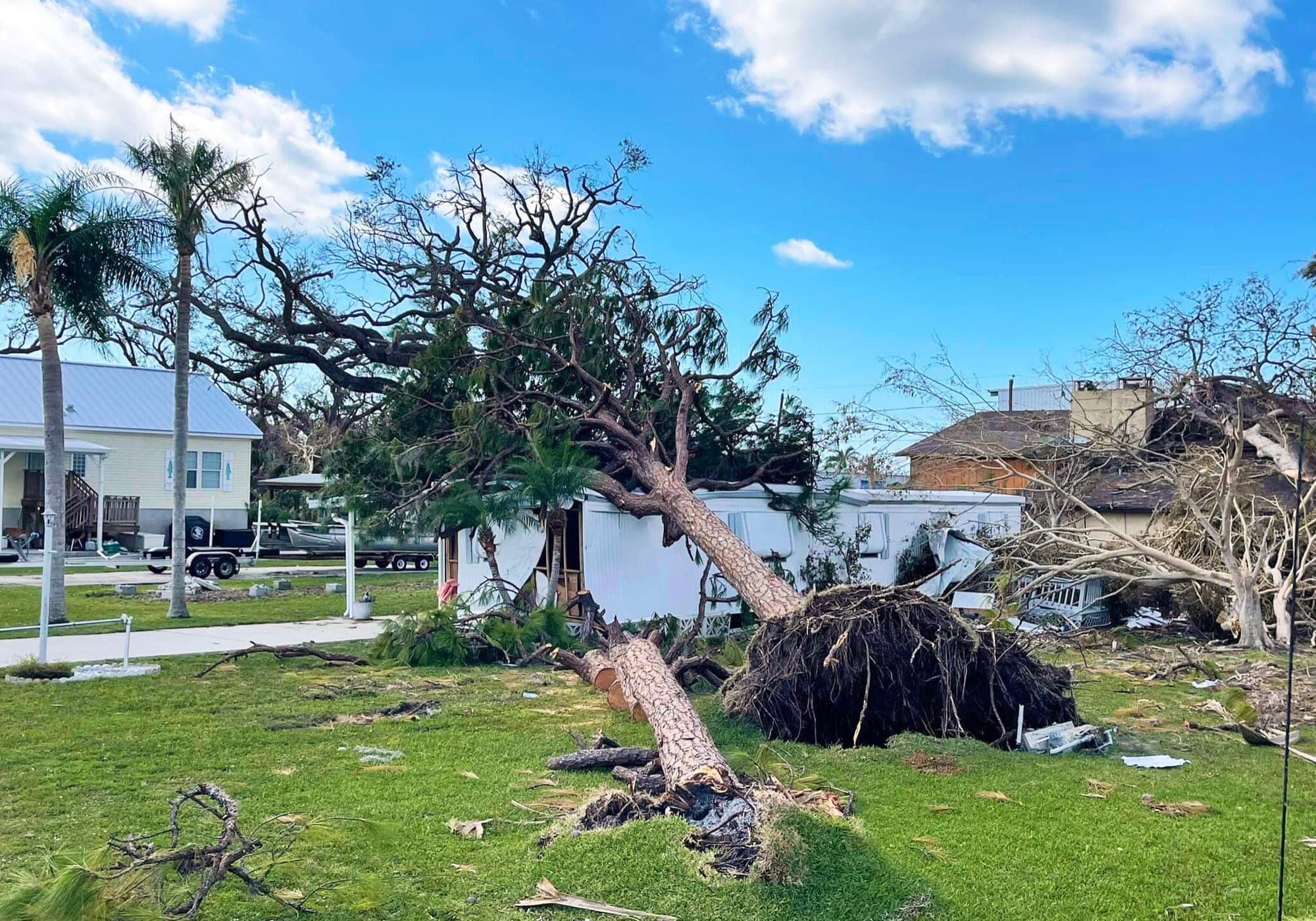
Hurricane Isaias came ashore near Destin on the evening of 9 October 2026 as a Category 2 storm. If you are reading this with a pine across the lawn and a yard full of limbs, here is the order we work in on our own clients' properties, and why.
Before you touch anything
Two things happen before the first cut.
Walk the property looking up, not down. The dangerous things after a storm are the ones that have not finished falling: limbs hung up in a canopy, a trunk that split but is still standing, a tree leaning with the soil heaved on the far side. Do not walk or park under any of them. If a line is down anywhere on the lot, treat it as live and call the utility. A tree resting on a service line is theirs to deal with, not yours and not ours.
Photograph everything before moving it. Your insurer will want to see the tree on the roof, not the stack of logs at the curb. Wide shots of the whole yard, closer shots of anything touching a structure, fence, screen enclosure or pool, and a shot of each tree's base. Do it on your phone, do it today, and do not delete them. Most policies cover removing a tree that fell on a covered structure and some cover debris removal up to a limit. General yard cleanup is usually on the owner, so an itemised invoice that separates the two is worth asking any crew for.
Days 1–3: make it safe
This is the only part of the job with a real order to it.
- Hangers come down first. A limb broken but still caught in the canopy is the thing that lands on someone three days later. Pull it down with a rope from a distance if it is small; leave it to a crew if it is not.
- Split trunks and leaning trees next. A tree that is leaning after the wind has dropped is still moving, just slowly. Look at the ground on the side opposite the lean: heaved or cracked soil means the root plate has lifted and the tree is no longer anchored. In coastal sand this is the usual way a tree fails, because a root plate in sand lifts rather than snaps. Those trees are braced or removed; they are not left to see what the next front does.
- Anything on a structure is a rigging job. A tree on a roof, a fence, a pool cage or a car gets taken down in sections and lowered, not cut free to drop. That is the one piece of this work we would not suggest a homeowner attempt, insurance or no insurance.
Everything else, the stuff lying flat on open grass, can wait a few days without getting any worse.
Days 1–5: clear and sort the debris
The counties and cities are running curbside collection for Isaias debris, but only for piles that are sorted and placed the way their contractor requires. Fort Walton Beach, for example, is collecting clean vegetative debris and storm-related construction debris as two separate piles, loose rather than bagged, away from hydrants, mailboxes and utility boxes, starting around 14 October. Walton County's standing guidance is to separate debris into categories and place it within ten feet of the road edge, away from mailboxes and poles, and it says plainly that unsorted or badly placed piles will not be picked up.
The full rules for each county, and what to do where collection is not running, are in our guide to storm debris pickup in Walton, Okaloosa and Bay. The short version:
- Vegetation in one pile. Limbs, trunks, fronds, shrubs.
- Fence boards, deck boards, screen panels and shingles in a second pile.
- Nothing in bags. Bagged piles are left behind.
- Not on the road, not over a drain, not under a line.
Blow off the pavers, the pool deck and the drive once the piles are out, and rake the beds. You will find the irrigation heads that got broken while you do it.
Week 1: stand your palms back up
Palms that lifted or are leaning are the most recoverable thing in the yard, but only if it is done early. A palm whose root ball is still mostly in the ground can be dug out on the leeward side, pulled upright, backfilled firmly, watered in and braced with three stakes for a season. Done in the first week or two, most of them come through. Left leaning for a month, the roots on the lifted side die and the palm declines slowly through the winter.
Two things not to do. Do not strip the fronds to "reduce stress" — the so-called hurricane cut starves the palm at the moment it most needs its leaves, and it does nothing for wind resistance after the storm has already passed. Remove only fronds that are fully brown or snapped. And do not stand up a palm with a cracked trunk or a crown that has broken over; those will not recover, however green they look this week.
Cabbage palms and sabals are the most wind- and salt-tolerant palms on this coast and are usually fine. Queen palms snap and lean more readily and have little salt tolerance, which is why they are so often the ones lying down.
Week 1: flush the salt
If surge or bay water stood on your lot, even for a few hours, salt is in the root zone now and it does its damage slowly. Lawns and shrubs that look fine the week after a storm brown out over the following month as the salt draws water out of the roots.
The cheapest thing you can do is flush with fresh water early: run the irrigation heavier than normal for a couple of weeks to push the salt down below the roots, as long as you have a fresh-water source to do it with. The University of Florida's guidance is to irrigate above normal evapotranspiration, roughly 30 percent more, to leach salts out. Do not fertilise yet; fertiliser is itself a salt. What recovers and what does not is covered in Will my lawn and plants survive salt water?
Week 2: triage what to keep
By the second week the yard is safe, the piles are at the curb and the first flush has gone through. Now you can make decisions.
Trees. A tree that lost leaves but kept its limbs will usually releaf. A tree that lost a major limb at the trunk has a wound to watch for a year, but it is not a removal. Torn limbs should be pruned back cleanly to the branch collar so the tree can seal the cut; a stub left behind decays into the trunk. A tree with a split union, a lifted root plate or a lean that was not there before the storm is a removal, and the sooner it is scheduled the less it costs, because every tree company on the coast is booked for weeks.
Shrubs and beds. Scratch the bark on anything that looks dead. Green under the bark means wait; brown and dry means it is gone. Woody shrubs that were only wind-burned or defoliated usually push new growth within a month, so give them that month before pulling them. Re-edge the beds and replace the mulch once the debris is out; the old mulch is full of salt and shredded leaf litter.
Irrigation. Turn the controller on zone by zone and walk it. You are looking for heads snapped off by debris, geysers where a line broke under a root plate, and zones that run weak because sand got into the lateral. If the system took salt water, flush each zone to a drain before you rely on it to water anything.
Sod. Hold off. See the salt-water guide above for how long to wait and what to replace it with if it does not come back.
What to leave to a crew
Anything that needs rigging, anything near a line, and anything that involves climbing. Also, honestly, the volume: a single mature pine makes several truckloads of debris, and a homeowner with a trailer spends a week moving what a crew with a chipper moves in a morning.
For what it is worth, this is what our storm cleanup service covers, start to finish: making the yard safe, cutting and hauling or stacking to the county's rules, standing up palms, pruning torn limbs, flushing and repairing irrigation, and replacing what is genuinely gone with sod and palms from our own nursery in Freeport. We are insured to two million dollars and send the certificate before we arrive. We do not run emergency call-outs, so if a tree is on your house right now, call a 24-hour service and your insurer before you call us.
Questions we get about this
Should I cut up the fallen tree myself?
If it is lying flat on open lawn and nothing is under tension, cutting it into movable sections is a reasonable job for a homeowner with a chainsaw they know how to use. If it is leaning on anything, if the root plate is lifted, or if the trunk is bent and loaded, leave it — those are the cuts that hurt people.
My palm is leaning but still green. Will it live?
Usually yes, if the root ball is still mostly in the ground and it is stood back up within a week or two. Dig out the leeward side, pull it upright, backfill, water it in and brace it for a season. A palm with a cracked trunk or a snapped crown will not recover.
Everything is brown. Do I need new sod?
Not yet. Lawns that sat in brackish water brown out over the following weeks even where the grass will recover. Flush with fresh water, wait three to four weeks, and judge then. St. Augustine and zoysia tolerate salt far better than centipede does.
Who takes the debris away?
After a declared storm the counties and cities usually run curbside collection, but only for debris that is sorted into separate piles and placed correctly. Fort Walton Beach and Crestview announced collection for Isaias; check your own county or city page for the rules at your address, or we can cut, sort and stack it for you.
How fast can Allgood get to me?
Honestly, not the same day. We don't run emergency call-outs, and in the weeks after a storm we schedule in the order calls come in. Send photos of the worst of it so we can tell you whether it is a half-day clear-up or a tree job, and we'll give you a real date.
Related services
More guides
Want a crew to do the heavy part?
Send two or three photos of the worst of it and your town. We'll tell you what it is, roughly what it takes, and when we can be there.
Allgood Outdoor Services Inc., 20502 US Highway 331 S, Freeport, FL 32439. 850.368.5917.